Voltage Monitor, Lightning Protection & Voltage Regulator (AVR): What Does Every Installation Really Need?;
The complete guide for installers: what each component does, why it protects your customer’s investment, and when each one needs to be fitted.
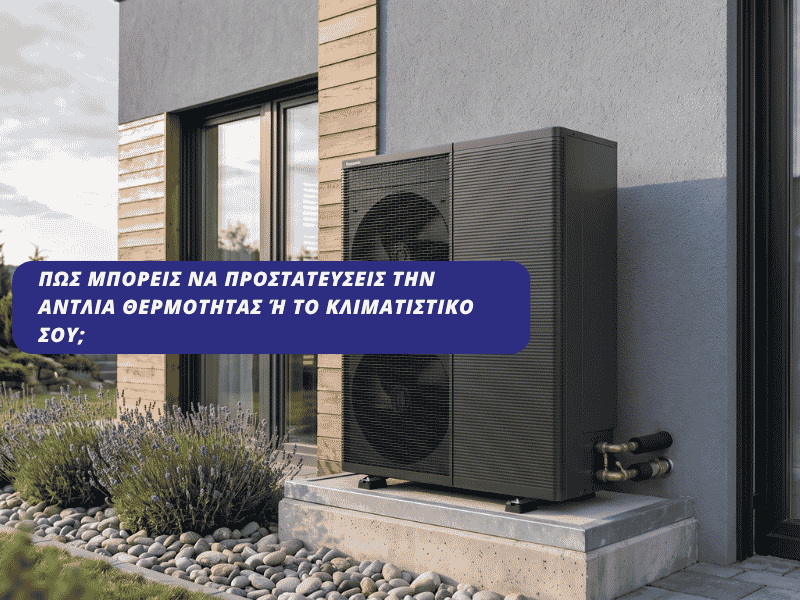
Modern heat pumps and inverter air conditioners are «smart» machines with sensitive and expensive electronic systems. A sudden power surge or a lightning strike can burn out a circuit board that costs as much as half the unit itself. At Alphatech’s technical department, we are often asked the same question: «What should I do to protect my pump?»
There are three different types of protective devices which installers very often confuse. They do not perform the same function and are not essential in every installation: the voltage monitor, the surge protectors (T2+T3) and the automatic voltage regulator (AVR). Let’s sort things out.
1. Supervisor Fuse: The essential protection that must ALWAYS be fitted
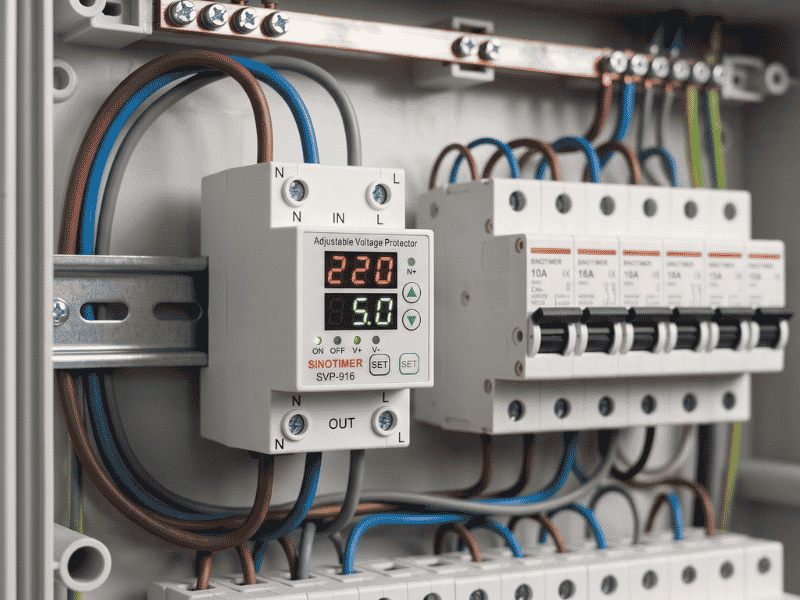
The voltage monitor is a small relay fitted to the switchboard which continuously monitors the mains voltage. When the voltage falls outside its set limits, it immediately disconnects the load and reconnects it only once the voltage has stabilised.
Why is a voltage monitor useful?;
- Protects the compressor: Low-voltage inverter operation «draws» more current and causes the system to overheat. The monitor acts as a cut-out before the compressor has a chance to burn out.
- It compensates for sudden fluctuations and dips: voltage dips caused by neighbouring loads starting up or an unstable HEDNO grid.
- Restart delay: an adjustable time delay to prevent the compressor from restarting whilst there is residual voltage — which is crucial to its service life.
Correct voltage monitor settings
The standard voltage for low-voltage networks is 230 V single-phase and 400 V three-phase. The permissible voltage fluctuation limits set by HEDNO are 207–253 V for single-phase and 360–440 V for three-phase, values which must be used in the monitor. However, the settings for response and reset delays are of greater importance. For most networks within urban centres, typical settings for heat pumps are 1–2 s for the response and 180 s for the reset.
A voltage monitor is an essential component in any heat pump or inverter air-conditioning installation. It is the most cost-effective safety measure in relation to the risk it covers and should be regarded as standard practice.
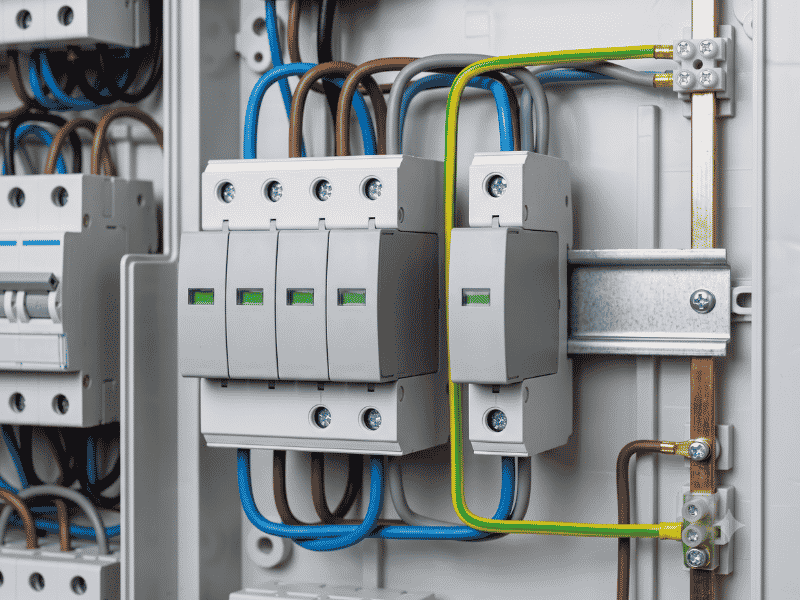
2. Lightning protection (T2+T3): Protection against overvoltage and lightning strikes
Lightning arresters (surge protective devices / SPDs) divert the transient surges caused by lightning strikes or operational faults in the network to earth. Unlike a circuit breaker, which cuts off the power supply, surge protectors «absorb» the energy surge within microseconds.
In commercial terminology, we refer to a T2+T3 combination: the T2 is installed in the main distribution board and handles the bulk of the current, whilst the T3 is fitted close to the sensitive equipment (e.g. in the heat pump control panel) and «clears» any residual overvoltage before it reaches the electronics.
When is it considered necessary to have one fitted?;
- In areas prone to frequent lightning strikes: mountainous, semi-mountainous and open rural areas with long overhead power lines.
- In installations with an exposed outdoor unit: rooftops, holiday homes, detached houses without any «protection» from neighbouring taller buildings.
- Where a lightning conductor is already in place or is required: In that case, the SPD is not optional but forms part of the lightning protection design.
Choosing the right lightning protection system
The choice depends on many factors, and it is best to seek advice from manufacturers of lightning protection equipment. Typical values for heat pump protection are:
- T2 on the main switchboard & T3 near the pump
- 1P+N for single-phase; 3P+N for three-phase
- Uc 275V for single-phase; Uc 275/440V for three-phase
- In 20 kA · Imax 40–50 kA · Up ≤ 1.5 kV
Lightning arresters only work if they are properly earthed. Without a reliable, low-resistance earth connection (~10Ω), an SPD has nowhere to dissipate the energy and protection is effectively non-existent. They are required less frequently than a surge arrester, depending on the mains supply and the installation’s exposure; in areas with a high risk of lightning strikes, however, they are an investment that saves on costs and hassle.
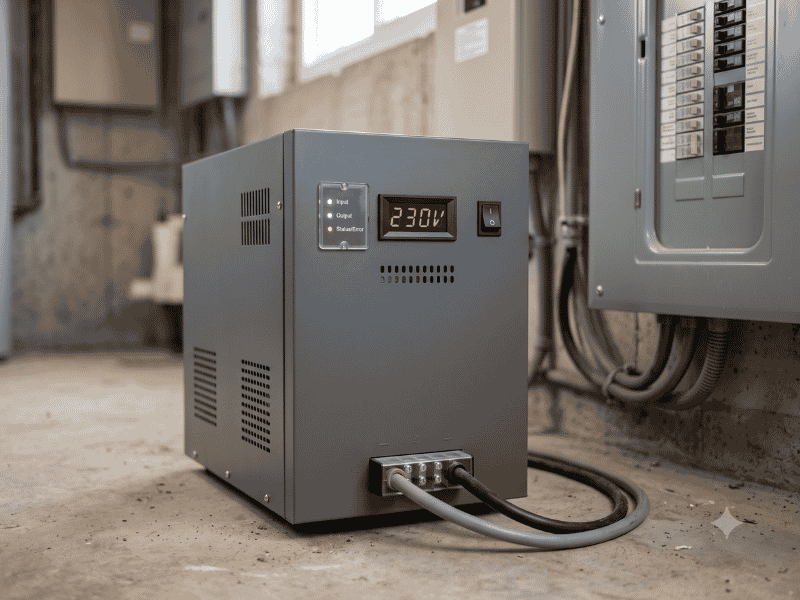
3. Voltage Regulator (AVR): The solution for truly «difficult» grids
The voltage stabiliser (Automatic Voltage Regulator) does not cut off the supply like a circuit breaker, but corrects it. It takes an unstable or consistently low/high input voltage and converts it to a stable ~230V (or 400V for three-phase) at the output, allowing the machine to operate normally even when the mains supply experiences significant fluctuations.
Where it is essential
- At network edges and in remote areas: where the voltage is consistently low and the circuit breaker would keep tripping, leaving the customer without heating.
- In networks with large and frequent fluctuations: agricultural facilities, islands, and areas with heavy industrial traffic on the same line.
- When the supervisor «closes» too often: Repeated disconnection due to low voltage is a sign that an AVR is required, rather than the removal of the monitor.
Choosing the right voltage regulator (AVR)
The choice must always be made in consultation with a qualified electrician. It is calculated based on the type of pump (single-phase or three-phase) and its maximum operating current. It is very important that it is compatible with an inverter, has an output accuracy of ±3% and is a static AVR.
It is rarely needed, only in very specific, problematic networks. In most urban installations, a monitor is sufficient; an AVR is used when the problem lies with the quality of the supply itself.
Comparison Table: When is each one needed?
| Voltage Monitor | Lightning protection (T2+T3) | Automatic Voltage Regulator (AVR) | |
|---|---|---|---|
| What does he do? | Cuts off the supply in the event of overvoltage or undervoltage | It diverts lightning surges to earth | Regulates and stabilises the voltage at 230V |
| Protects against | Voltage fluctuations and dips | Lightning strikes & network operations | Persistently unstable/low voltage |
| Frequency of need | ALWAYS | Often, depending on the network | Rare, specialised networks |
| Installation point | Machine panel | General table (T2) · device table (T3) | In front of the machine’s control panel |
Do they go together?;
Yes, and ideally they work in tandem. In a demanding installation, the correct protection chain is: a voltage monitor as the first line of defence, which cuts off the supply if anything goes wrong; T2 surge arresters in the distribution board and T3 surge arresters on the pump; and a voltage stabiliser (where required) to correct the voltage. Each addresses a different risk, and none replaces the other.
Frequently Asked Questions (FAQ)
In most urban installations with a fixed mains supply and a low risk of lightning strikes, yes. The regulator handles day-to-day fluctuations. Lightning arresters and AVRs are only added when required by the location and the quality of the power supply.
No. The circuit breaker cuts off the power supply when the voltage goes outside the specified limits; the voltage stabiliser corrects it so that the machine can continue to operate. In a mains supply with a consistently low voltage, the circuit breaker would trip constantly, and an AVR would be required.
Often, yes. Most power surges do not result from a direct strike, but from induced phenomena caused by nearby lightning strikes and operations on the power grid. In exposed installations, a T2+T3 with proper earthing provides protection even without a lightning conductor.
T2 in the main supply panel and T3 near the sensitive device, usually in the heat pump panel or the outdoor unit, to clear any overvoltage.
Alphatech is there for you at every installation
With over 40 years’ experience When it comes to cooling, heating and air conditioning, at Alphatech we don’t just provide you with the equipment – we also give you the expertise to look after it. Whether you’re installing a Panasonic Aquarea heat pump or an inverter air-conditioning unit, our team will help you choose the right protection for your customer’s specific system.