Correct Application, Common Problems & Solutions
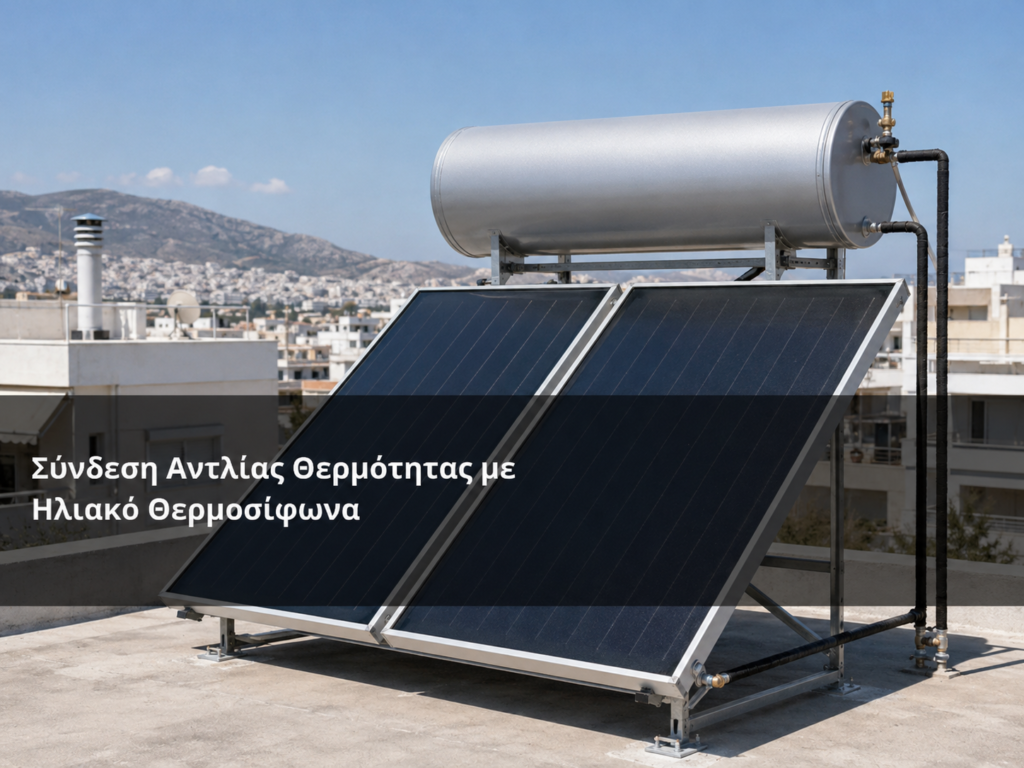
Greece has one of the highest rates of solar water heater penetration in Europe and enjoys a level of sunshine that most countries would envy. It is therefore no coincidence that the most common combination an installer is called upon to manage today is a αheat pump with an existing or new solar water heater. In theory, it sounds ideal: free solar energy reduces the load on the DHW system and increases the system’s actual efficiency. In practice, however, it is the details that make all the difference to a job well done.
In this guide from Alphatech’s technical department, we analyse the correct connection methods, the problems we have encountered, as well as practical solutions that ensure reliable operation, hot water and a trouble-free installation.
Does it actually make sense to combine a heat pump with a solar water heater?;
Let’s think about it logically. A solar water heater produces hot water at zero energy cost for most of the year. When there is insufficient sunlight – whether due to cloud cover or because it is winter – or during periods of increased evening demand, the heat pump takes over to upload or complete the water temperature. The aim is for the pump to operate as little as possible and always on a preheated base, so that the plant’s actual efficiency remains high.
The most common ways to connect
There are various ways of connecting a heat pump to a solar system, and they can all work properly, provided they are installed correctly their connection and installation.
1. Triple-energy boiler room boiler (the cleanest solution)
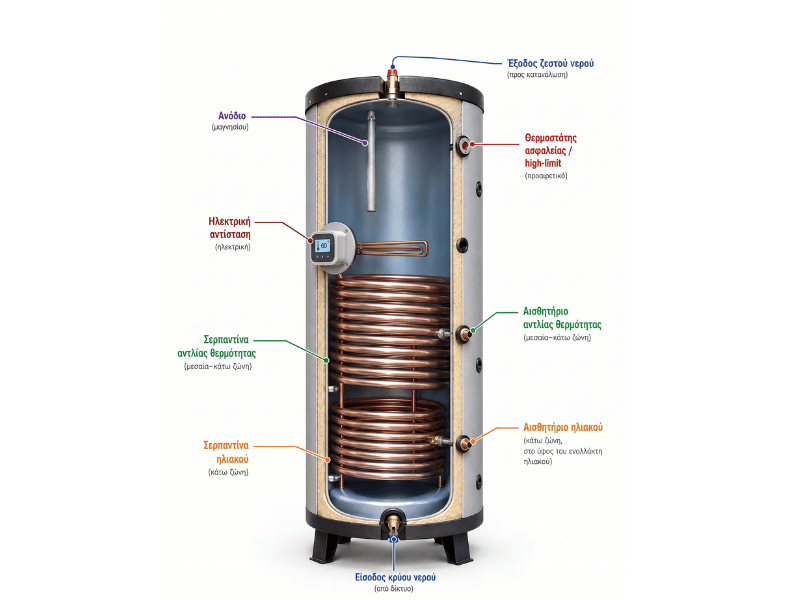
The ideal scenario for a new installation is a DHW tank in the boiler room with two heat exchangers (coils). The lower (small) coil is supplied by the solar collectors via a circulator and a differential controller, the upper (large) coil by the heat pump, and there is also a heating element for emergency use. The principle behind stratification is natural: the sun preheats the entire volume from below, whilst the heat pump maintains the temperature only when necessary.
- Advantage: Clear separation of heat sources, maximum use of solar energy; the pump operates only as a backup.
- What you need to bear in mind: correct positioning of the temperature sensors (below the solar collector, above the heat pump), heat pump coil of at least 1,9m2 and a container capacity sufficient to meet demand.
2. Triple-energy roof-mounted boiler (the most common installation)
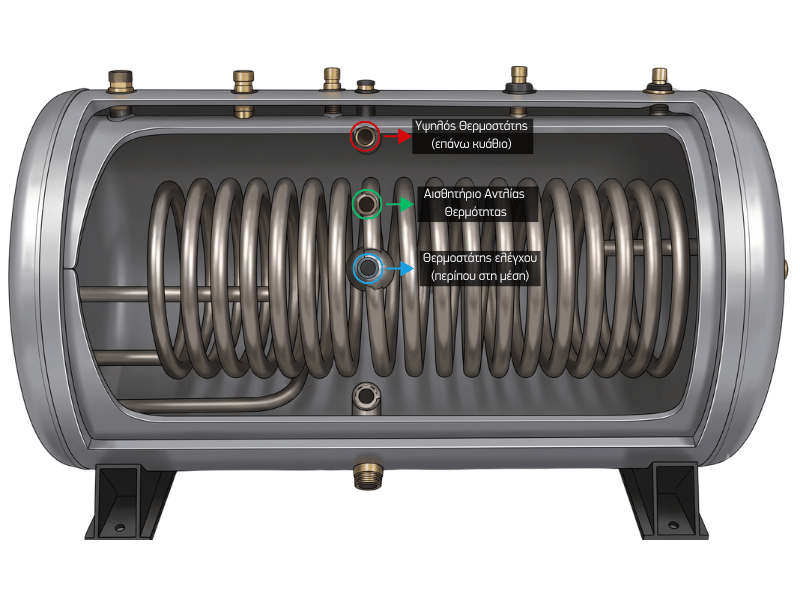
In most Greek homes, due to a lack of space and a dedicated boiler room, solar water heaters are installed on a flat roof or rooftop. This is similar to the previous system, but here the solar collector heats the DHW tank directly, with the pump operating as a backup via an internal heat exchanger (coil), whilst the heating element is again intended for emergency use only.
- Advantage: Easy to install, maximises solar energy; the pump operates only as a backup.
- What you need to bear in mind: The correct positioning of the temperature sensors (in the middle for the pump, at the top for the booster) and the heat exchanger for the heat pump (at least 1,9m2) These are much more important here and require careful consideration. Furthermore, the long distances of the pipes from the pump to the solar water heater must be taken into account and factored in before the final installation.
3. Series connection with an existing solar water heater (the most complex installation)
In many Greek homes where there is already a solar water heater, A heat pump is added. Here, the solar system should act as a preheating tank: the preheated water flows into a separate boiler tank connected to the heat pump, which, via the internal heat exchanger, simply raises it to the target temperature. Because the pump starts from a warm base, its energy consumption is significantly reduced.
- Advantage: use of the old solar system and preheating of the DHW tank to minimise pump usage in summer and maximise its efficiency in winter
- What you need to bear in mind: The installation requires a qualified plumber, who will use all the necessary materials (e.g. solar bypass valve, expansion tank, sensors, etc.) and will pay particular attention to the correct layout for DHW stratification. The pump sensor must be positioned in the centre, and the boiler coil in the boiler room must be suitable for a heat pump (at least 1,9m2).
What problems might you encounter and how to solve them
Problem 1: An unsuitable or undersized heat exchanger for a heat pump
A simple solar water heater does not have a second coil to which the pump can be connected. Attempts at a «makeshift» connection result in poor heat transfer and disappointing performance. Even in the case of triple-energy solar systems, the heat exchanger for the heat pump is small, resulting in flow errors or high compressor pressure errors!
Solution: Selection of a dual/triple-action tank with sufficient heat exchanger surface area (at least 1,9m2) as per the design. Furthermore, the heat pump should be connected to the boiler using the largest possible pipe diameter (at least 1”) and at a minimum distance of 3 metres, to ensure the highest possible flow rate!
Problem 2: Incorrect positioning and adjustment of sensors
If the solar or pump sensor is fitted at the wrong height on the tank, the system will not work properly: it will either switch on the pump when solar heat is available, or leave the user without hot water.
Solution: Follow the manufacturer’s instructions regarding the position of each sensor per zone, as mentioned above. Separate sensors for the solar collector (bottom) and the pump (top). Verify the differential (ΔΤ) start/stop settings following installation in a solar system; careful, precise positioning of the pump sensor in a horizontal triple-energy boiler (in the middle and as centrally as possible within the tank).
Problem 3: Poor DHW temperature control
During the summer months, the solar system can raise the temperature of the water in the tank well above the target temperature – even to 80–90 °C on sunny days. This creates two risks: the water becoming too hot and components suffering thermal stress. On the other hand, in winter the pump may operate at a relatively low setpoint to achieve a better COP, without reaching the desired domestic hot water temperature
Solution: For the summer, a reduction in the temperature setpoint for the pump and mandatory installation mixing valve at the DHW outlet. It maintains a safe temperature at the taps regardless of how hot the tank is. Furthermore, it allows the tank to store more energy. For the winter, increase the temperature setpoint on the pump and use the electric heating element periodically for optimum performance!
Problem 4: Reverse flow
In natural circulation systems or where pipework is poorly routed, hot water may «flow back» through the circuits at night, cooling the tank and negating the day’s solar gain.
Solution: Installation of non-return valves at the correct points and heat traps at the joints. Correct pipework slope and insulation.
Proper installation starts with choosing the right equipment. The Panasonic Aquarea heat pumps The products we offer support all automation features for the flexible integration of solar systems and source priority logic – precisely the features that make all the difference in these installations.
At the same time, we support every installation with the right accessories: buffer tanks, solar thermostatic valves, circulation pumps and plumbing fittings. And, above all, with technical support backed by over 40 years’ experience, both before and after the sale.