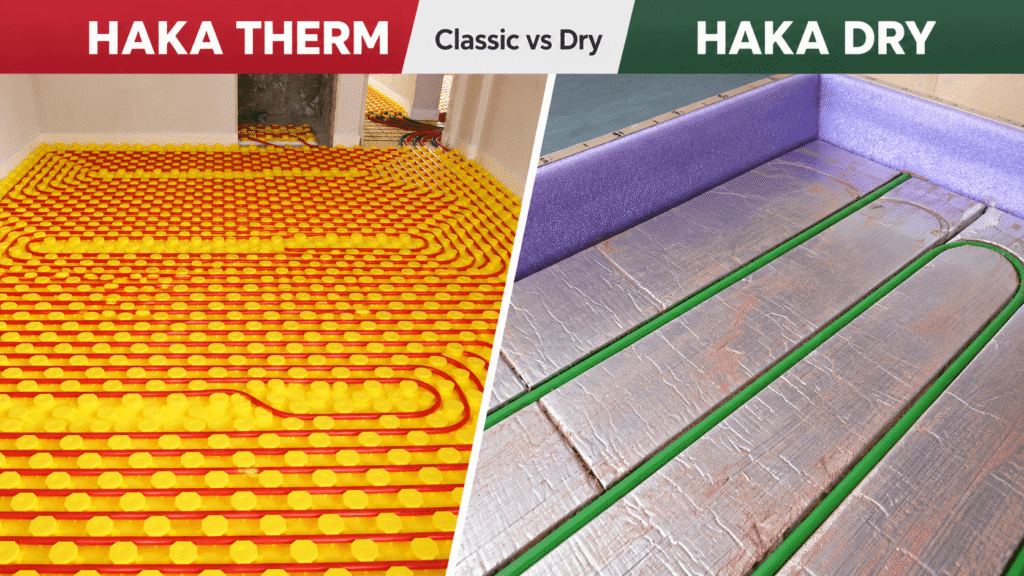
Classic vs Dry: a comparison of construction and response | Part 1
This article is the first part of a comprehensive study aimed at helping the reader to choose the right type of underfloor construction for their own project.
The choice between traditional underfloor heating with a concrete screed and a dry-lay system is not simply a comparison of two installation methods. It affects the overall floor height, the additional weight placed on the structure, the time taken to complete the work, the thermal response and, ultimately, the actual cost of the project.
For an architect or engineer, therefore, the right question is not «which system is best?», but which one best meets the constraints and operational requirements of that particular building.
In this guide, we compare the classic HAKA THERM underfloor heating system with the low-profile HAKA DRY underfloor heating system, so that the choice can be based on the actual project specifications.
How underfloor heating works
Hydronic underfloor heating uses pipes laid beneath the floor structure. The water circulating through the pipes heats the surface, which then distributes the heat evenly throughout the room via radiation, convection (solid-solid) and conduction (solid-fluid) of heat.
As it operates at relatively low water temperatures, it can be effectively combined with heat pumps and other low-temperature heat sources.- In the classic HAKATHERM underfloor heating system, the pipes are covered with thermal concrete or cement screed, which in turn heats up evenly and stores heat.
- In the HAKA DRY dry-construction system, heat is transferred via special thermally insulating panels coated with aluminium foil, which offer the same capacity as thermal concrete for uniform heating, without the need for preheating
What is the classic HAKA THERM underfloor heating system?;
In the standard installation, the pipework is laid on top of the thermal insulation layer and encased in thermal concrete. The thermal concrete acts as a large thermal mass: it stores energy and gradually releases it into the space.
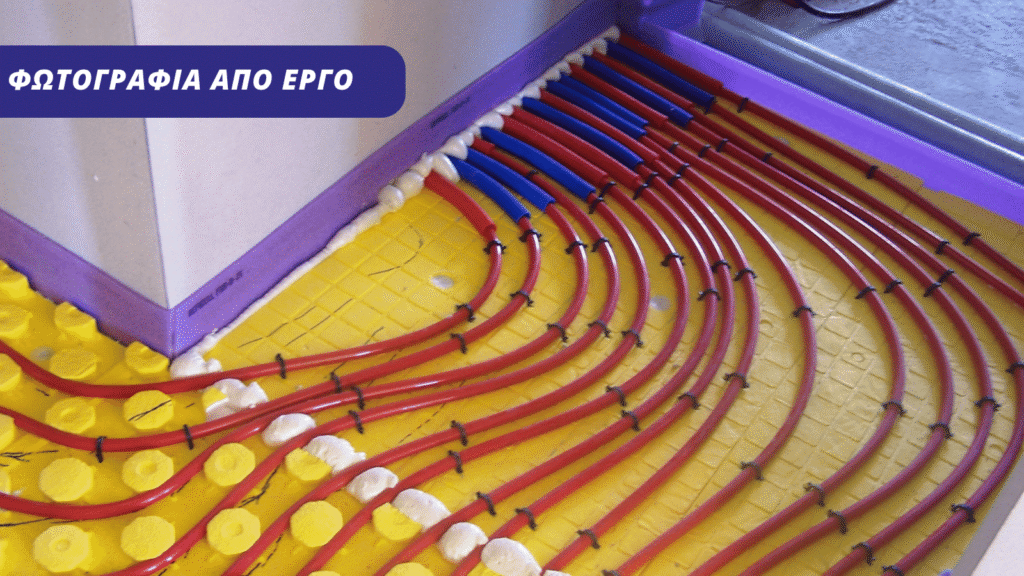
Installation of Haka Therm Classic underfloor heating in a real-life project and a cross-sectional view of the system
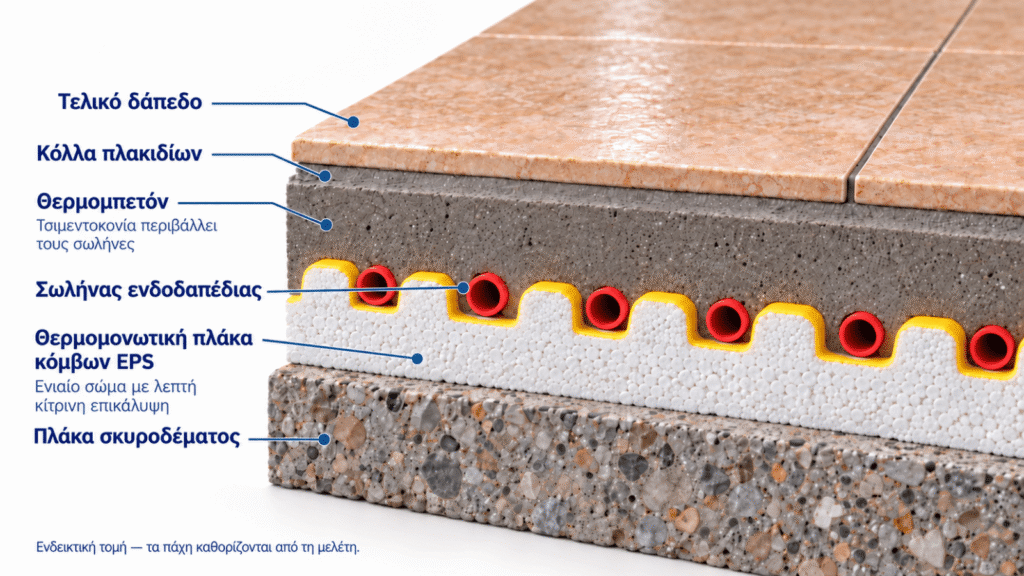
Advantages of traditional construction
High thermal inertia. The floor retains its temperature for a considerable time after the heat supply has been cut off. This is useful in buildings that are in constant, continuous use.
Consistent thermal behaviour. With proper compensation and without frequent changes to the set temperature, it provides a stable thermal environment.
Suitable for new builds. In a new building, the required thickness, the additional weight and the drying times can be planned for from the outset.
Constraints that need to be taken into account
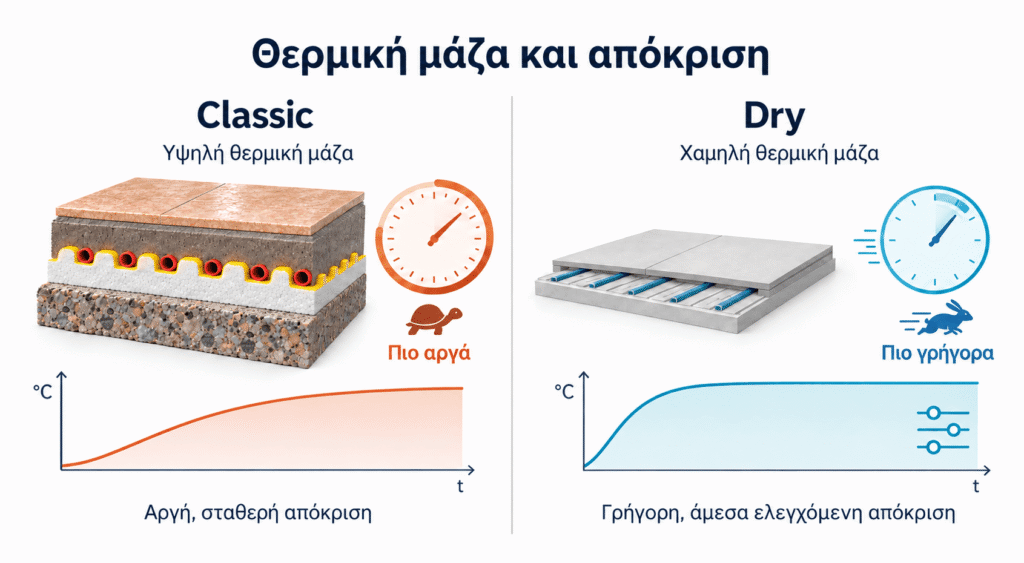
Traditional underfloor heating requires greater installation height and adds significant weight. The application of thermal concrete generates moisture and requires a curing period before the final surface can be laid. The high thermal mass also means a slower response to both heating and cooling.
What is the HAKA DRY in-floor dry construction system?;
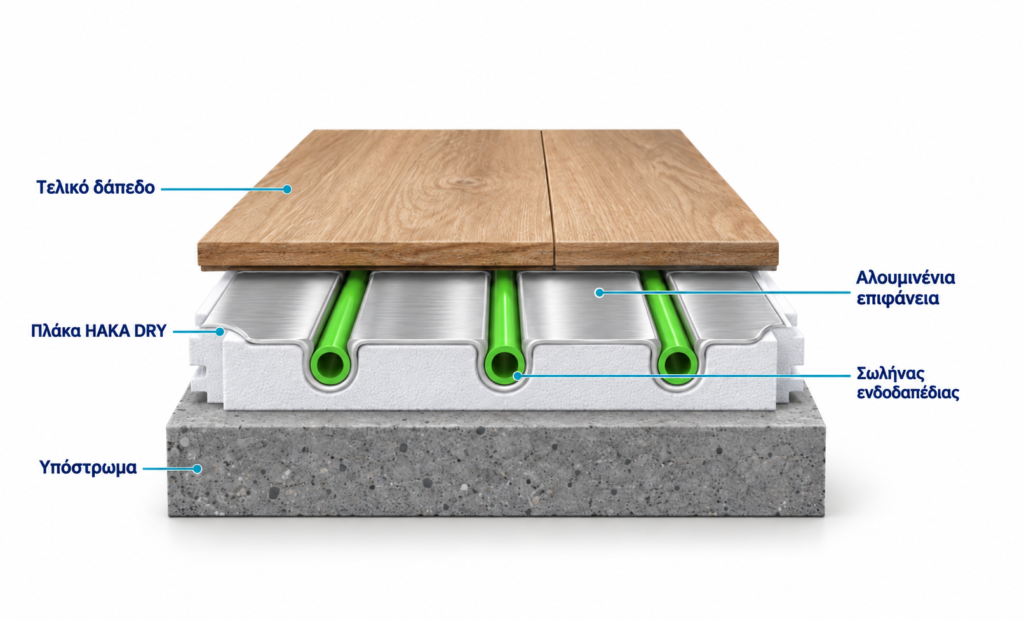
HAKA DRY operates without the pipework being encased in thermal concrete. It consists of 25 mm thick EPS 300 thermal insulation panels, with a heat-conductive aluminium surface for the direct and uniform distribution of heat.
A HAKA PE-RT/AL/PE-RT pipe (14 × 2 mm) is installed in the grooves of the panels. Heat is transferred quickly to the surface, without the need to first heat a heavy layer of thermal concrete.
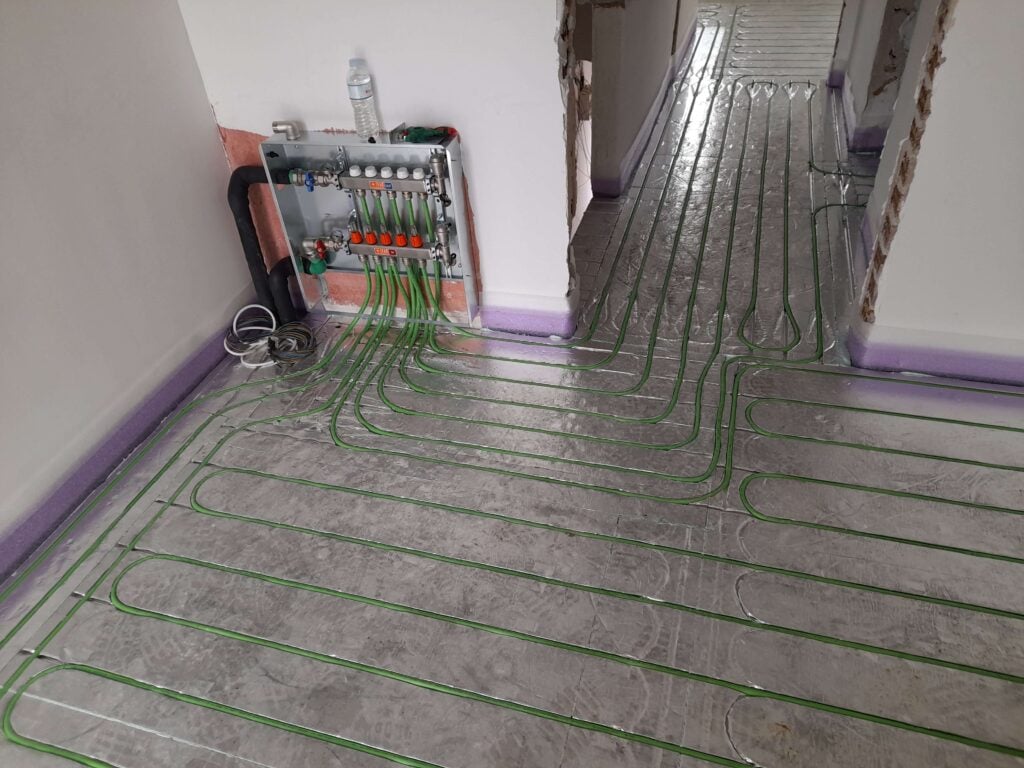
Installation of Haka Therm Dry underfloor heating in a real-world project and a cross-section view of the system
Advantages of HAKA DRY
Low overall height. The thickness of the application, together with the final floor covering, can be approximately 40 mm, depending on the type of covering and the design of the project.
Much lighter. Each EPS 300 panel weighs approximately 1 kg. The absence of thermal concrete significantly reduces additional permanent loads.
Quick installation. The slabs are easy to cut and fit, and there is no need to allow time for the screed to dry.
Immediate thermal response. The low thermal mass allows for rapid changes in output — a useful feature for spaces that are used intermittently.
Thermal and acoustic insulation. The panel provides 25 mm of thermal insulation with a thermal conductivity of λ = 0.033 W/(m·K) and, depending on the overall construction, can help reduce impact noise by 16–17 dB.
Mechanical strength. The system is designed to withstand loads of up to 500 kg/m² when installed in accordance with the technical specifications.
More on thermal behaviour and mechanical strength: HAKA DRY dry-installation underfloor heatingClassic vs dry: a comparison in a table
| Criterion | Classic – HAKA THERM | Dry – HAKA DRY |
|---|---|---|
| Total thickness/height* | Approximately 120 mm, depending on the study | Approximately 40 mm including the finished floor, depending on the surfacing |
| Additional weight | Higher due to thermal concrete | Much lower |
| Installation time | Larger, with a longer ripening period | Significantly smaller |
| Thermal response | Slow and steady | Fast and immediately controllable |
| Thermal mass | High | Low |
| Application moisture content | Yes, the thermobeton requires preheating | Minimal or none at all, depending on the final coating |
| Best suited for | New construction projects and ongoing operations | Refurbishments, height restrictions and intermittent use |
| Initial system cost | Lower costs for underfloor heating materials: pipes, moulded panels, manifolds, etc. | Higher-quality underfloor heating components: pipes, manifold, collector, etc. |
| Total project cost | This includes thermal concrete, additional labour costs and waiting time. | No cost for thermal concrete, with reduced labour, time and ancillary work. |
*Prices are indicative. The final stratification depends on the design, the substrate and the final coating.
Which of the two systems performs better?;
There is no one-size-fits-all answer for all buildings. The classic HAKATHERM underfloor system is not more powerful simply because it contains more thermal concrete: the increased mass stores heat, but delays the response. Similarly, HAKA DRY is not more efficient simply because it heats the space more quickly. Its advantage lies in its ability to adapt quickly to the space’s needs, much like conventional radiators.
Proper assessment requires:
- study of heat losses and available effective surface area,
- checking the thermal resistance of the finished floor,
- correct sizing of circuits and power supplies,
- • setting the flow temperatures and ensuring appropriate control with compensation.
Conventional and dry underfloor heating are not competing solutions with a clear winner. They are two different design tools.
HAKA THERM utilises thermal mass and is particularly well suited to new builds requiring stable operation. HAKA DRY offers a low profile, light weight, quick installation and immediate thermal response, addressing the key constraints of a refurbishment project.
The final choice must be based on the thermal analysis and an overall assessment of the building — not simply on the price per square metre.
Are you planning a new build or a renovation? Contact Alphatech so that we can assess the project’s requirements and select the most suitable underfloor heating system.