The R290, i.e. high-purity propane suitable for refrigeration applications, is steadily gaining ground in modern heat pumps. The reason is clear: it has a very low environmental footprint and can support efficient operation even at high water temperatures.
R290, however, remains a Class A3 flammable refrigerant, which requires particular care. This does not mean that it is inherently a dangerous choice. It means that the design, installation location and maintenance work must comply with specific regulations.
So, what do installers and engineers need to know before undertaking an R290 installation?;
The safety of an R290 installation depends on the right equipment, correct layout and appropriate working procedures.
What is R290 and why is it used in heat pumps?;
R290 is a natural propane-based refrigerant. It is not a fluorinated gas (F-GAS) and has an extremely low global warming potential.
According to European Commission data, R290:
- it has a very low GWP,
- does not deplete the ozone layer,
- is classified in safety category A3,
- It is an alternative to a number of synthetic refrigerants,
- It can be used in efficient heating and hot water systems.
Category A3 indicates lower toxicity but high flammability. This is the key difference that must be taken into account during design and installation.
In most domestic applications, R290 heat pumps are monobloc units. However, even in split units, the refrigerant circuit is sealed within the outdoor unit, whilst water – rather than refrigerant – circulates inside the building. This design significantly reduces the need for work involving intervention in the refrigerant circuit.
Why is R290 at the centre of the new regulations?;
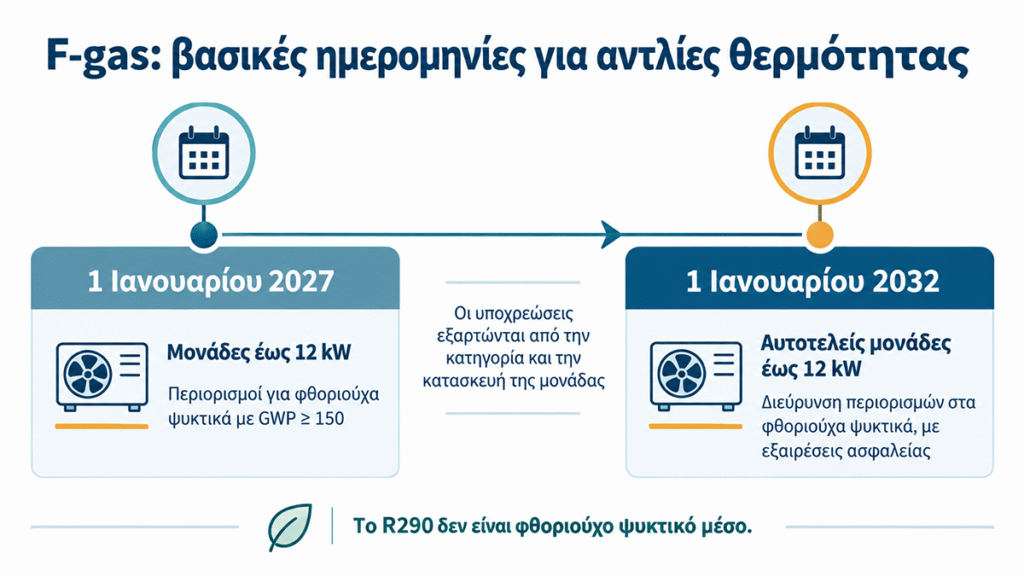
The European Regulation (EU) 2024/573 accelerates the phase-down of fluorinated gases and introduces new restrictions on air-conditioning equipment and heat pumps.
By way of example, the following are specified for air-to-water heat pumps:
The following timetable summarises the key dates. The exact
Requirements depend on the category, power rating and construction of the equipment.
| Date | Category | What’s changing |
|---|---|---|
| 1 January 2027 | Standalone units up to 12 kW | The import from third countries of units containing fluorinated refrigerants with a GWP of ≥ 150 is restricted. |
| 1 January 2027 | Specific units: 12–50 kW | Additional restrictions apply, depending on the type and design of the equipment. |
| 1 January 2032 | Standalone units up to 12 kW and 12–50 kW | The ban on fluorinated refrigerants is being extended, with exceptions to be made for safety reasons. |
The dates and exceptions vary depending on the category, capacity and design of the equipment. Consequently, the designer should not treat all types of heat pumps as a single category.
R290 is not subject to the European phase-out scheme for F-gases, as it is not a fluorinated gas. Its selection, however, does not exempt the installer from the safety, training and certification requirements relating to flammable refrigerants.
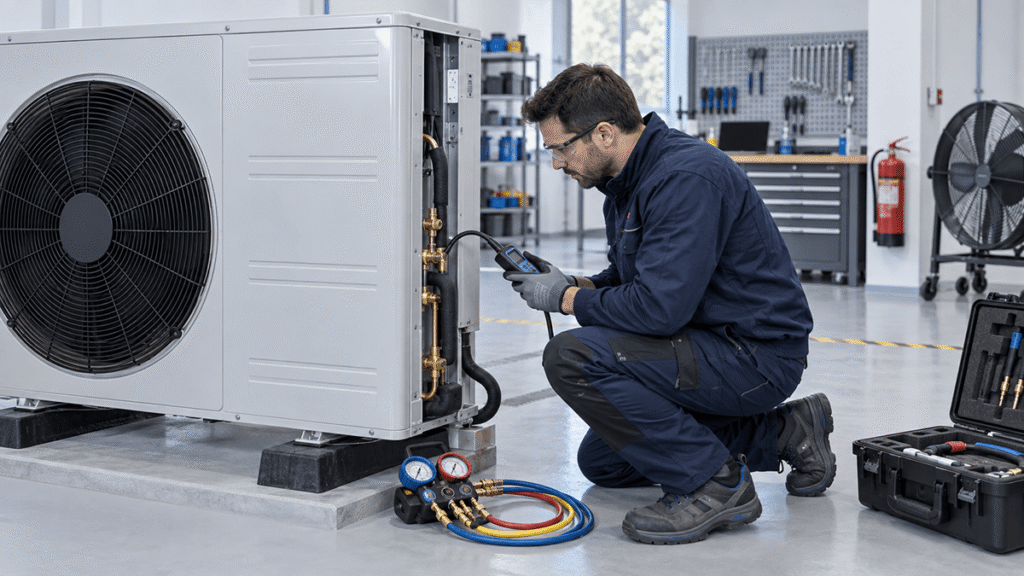
R290 heat pump: key safety measures
The safety of a facility does not depend on a single measure. It results from a combination of the correct choice of equipment, appropriate layout, controlled installation and safe maintenance procedures.
Modern, factory-designed R290 units incorporate safety measures specified by the manufacturer and dictated by their specific design. Provided it is correctly sited and the instructions are followed, R290 is not a reason to avoid a heat pump solution; it is a refrigerant that requires a properly documented, professional installation.
Follow the manufacturer’s instructions
The primary source of technical requirements is always the manual for the specific unit. The manufacturer specifies, amongst other things:
- the required safety distances,
- the permitted installation locations,
- the dimensions of the protected zone,
- restrictions near openings and potential sources of ignition,
- ventilation requirements,
- safety measures during maintenance.
Attention: Safety distances vary from model to model. General figures should not be used in place of the manufacturer’s instructions. |
Choosing the right position
Propane is heavier than air. In the event of a leak, it may flow towards lower-lying areas and accumulate in cavities or poorly ventilated spaces.
The unit must not be installed without a specific assessment:
- next to streetlights or recesses,
- near openings leading to basements,
- above or next to manholes and drains,
- in enclosed spaces with inadequate ventilation,
- near windows, doors or air vents, where these are situated within the safety zone specified by the manufacturer.
It is also important to avoid creating «pockets» in which the gas could remain.
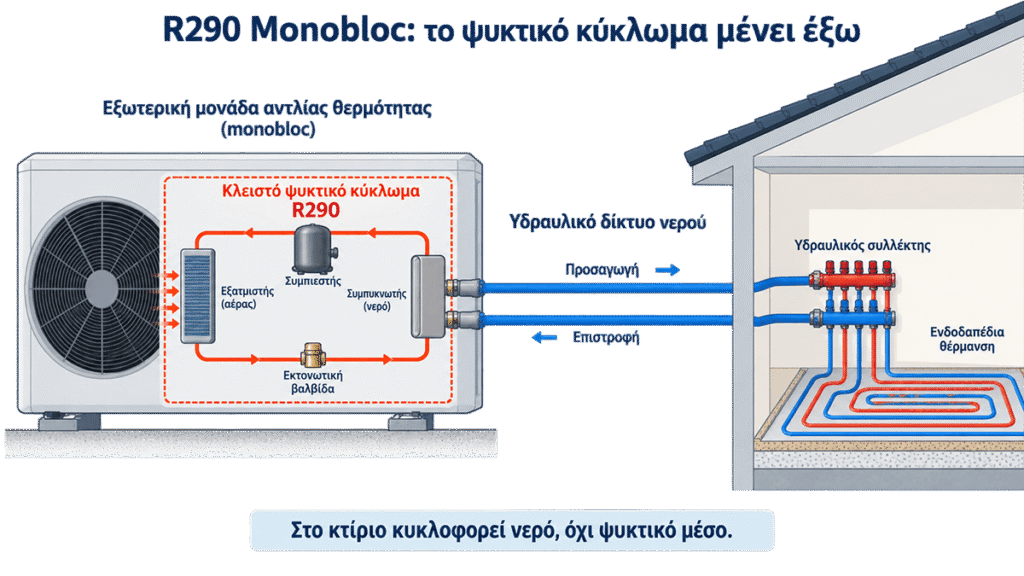
Removal of ignition sources
There must be no active or potential sources of ignition within the safety zone specified by the manufacturer. These may include:
- open flame,
- burners and gas appliances,
- switches or electrical equipment that is not suitable for the specific location,
- hot surfaces,
- sparks from tools,
- smoking or hot-work operations.
The safety zone must remain unobstructed even after the project has been handed over. It is not enough for it to be clear only on the day of installation.
Protection against mechanical stress
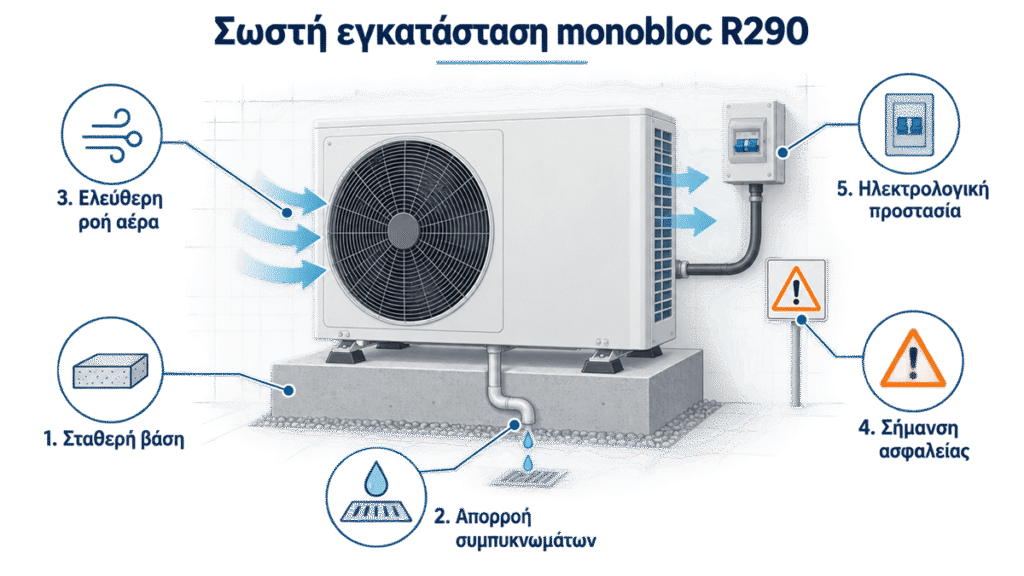
The outdoor unit must be installed on a stable base and protected from potential impacts, particularly when situated near a car park, a road or a busy thoroughfare.
Where necessary, protective barriers may be provided. However, these must not restrict air flow or obstruct access for safe maintenance.
Particular attention should also be paid to:
- to support the water pipes,
- in the discharge of condensate,
- for frost protection,
- to avoid any modifications that alter the unit’s casing.
Appropriate repair/maintenance procedures
Work on an R290 refrigeration circuit should not be treated in the same way as routine work on a non-flammable refrigerant.
Before work commences, the following are required, depending on the type of work and the manufacturer’s instructions:
- Inspection and demarcation of the work area.
- Remove or deactivate any potential sources of ignition.
- Adequate ventilation of the area.
- Check using a suitable flammable gas detector.
- Use of tools and equipment suitable for Class A refrigerants
- Safe recovery or removal of the refrigerant, where required.
- Follow the cleaning and deactivation procedure specified by the manufacturer before carrying out any work that could generate heat or sparks.
- Final leak test and safe recommissioning.
Which standards apply to R290 installations?;
The key technical guidelines for heat pump safety include:
- the EN 378 series of standards for refrigeration systems and heat pumps,
- EN IEC 60335-2-40 on the safety of electric heat pumps, air conditioners and dehumidifiers,
- ISO 817 on the classification and nomenclature of refrigerants,
- the manufacturer’s installation, operation and maintenance instructions,
- the applicable national requirements for electrical installations, fire safety and health and safety at work.
IEC 60335-2-40 includes specific provisions for flammable refrigerants, such as labelling, avoidance of ignition sources, leak detection and safe shut-off provisions, depending on the design of the equipment.
Standards must not be applied in isolation. The installer needs to consider which version has been adopted, what its scope is, and how it relates to the specific unit and the specific project.
What are the requirements for the certification of technicians?;
Implementing Regulation (EU) 2024/2215 broadens the European certification framework. It no longer applies solely to fluorinated refrigerants, but also covers related work on equipment using alternative refrigerants, such as:
- hydrocarbons, to which R290 belongs,
- carbon dioxide,
- ammonia.
The scope includes the installation, repair, maintenance and decommissioning of fixed refrigeration, air-conditioning and heat pump equipment.
For natural persons, different types of certificates are provided for, depending on the refrigerants and the tasks covered. Member States shall implement the relevant certification schemes and transitional procedures at national level.
Therefore, before carrying out any work on the refrigeration circuit, the technician must ensure that:
- has the appropriate training,
- is covered by the required certification,
- is familiar with the procedures for working with A3 refrigerants,
- uses suitable equipment,
- complies with the national requirements in force at the time the work is carried out.
The installation of a factory-sealed monobloc unit, such as the Panasonic Aquarea T-CAP R290, provided that the refrigeration circuit is not opened, this does not technically constitute a repair or refilling operation. This does not negate the requirements for correct positioning, electrical connection, hydraulic installation and compliance with safety instructions.
Checklist prior to handover of the installation
Before commissioning an R290 heat pump, it is advisable to check at least the following:
R290 unit installation checklist
- The installation location complies with the manufacturer’s manual.
- The required safety zone has been marked out and remains clear.
- There are no shafts, cavities or openings at an unauthorised distance.
- There are no sources of ignition within the protected area.
- The unit is securely fixed in place and protected against impact.
- The airflow around the outdoor unit is not obstructed.
- The discharge of condensate has been correctly provided for.
- The necessary frost protection measures have been put in place.
- The electrical safety devices and earthing have been checked.
- The warnings regarding the flammable refrigerant are clearly visible.
- The owner has been informed that they must not alter the area around the unit.
- The model, the quantity of coolant and the necessary maintenance instructions have been recorded.
Frequently Asked Questions about R290
Yes, provided it is properly designed, certified and installed in accordance with the manufacturer’s instructions and the applicable standards. The high flammability of R290 requires specific measures, but this is already taken into account in the design of modern units.
Installation feasibility depends on the type of unit, the quantity of refrigerant, the volume and ventilation of the space, as well as the manufacturer’s specifications and relevant standards. It should not be automatically assumed to be acceptable.
Not necessarily. The units already incorporate all the necessary safety measures in the event of any leak, ensuring that the refrigerant is rapidly vented into the atmosphere. The need for an additional detector depends on the unit’s design, the quantity of refrigerant, the location and the technical solution employed. However, a suitable portable detector is required for work where checks are to be carried out for the possible presence of flammable gas.
The equipment must be explicitly suitable for R290 and A3-class refrigerants. This applies, amongst other things, to leak detectors, vacuum pumps, recovery units, scales and power tools.
No. Only R290 refrigerant of the required purity and specification must be used. Standard propane fuel may contain impurities, moisture and odour-causing substances that render it unsuitable for use in a refrigeration circuit.
R290 is one of the most significant trends in the European heat pump market. Its very low GWP and technical specifications make it particularly attractive, especially as the use of fluorinated refrigerants is being phased out.
The transition, however, requires technical knowledge. Correct positioning, maintaining a safety zone, using suitable tools and training technicians are essential prerequisites for a safe installation.