Buffer: When is it really necessary in Heat Pumps?;
We answer the most common question of installers. See when to use a buffer, when not to, and how to calculate the correct litres.
One of the most frequent questions we receive in Alphatech's technical department is: “Do I eventually need a Buffer? And if so, how many litres?”
Let's put things in order. Inverter technology has evolved, but the laws of thermodynamics remain the same. In many cases, the Buffer is not just an output, it's a way to protect your installation.
1. When is the Buffer REQUIRED?;
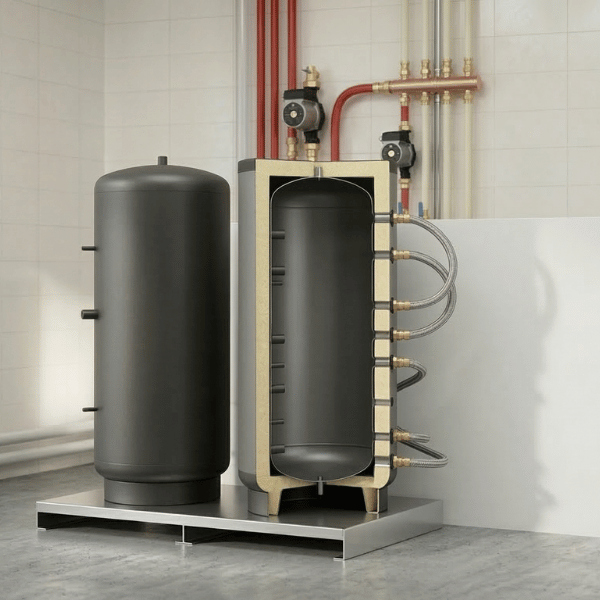
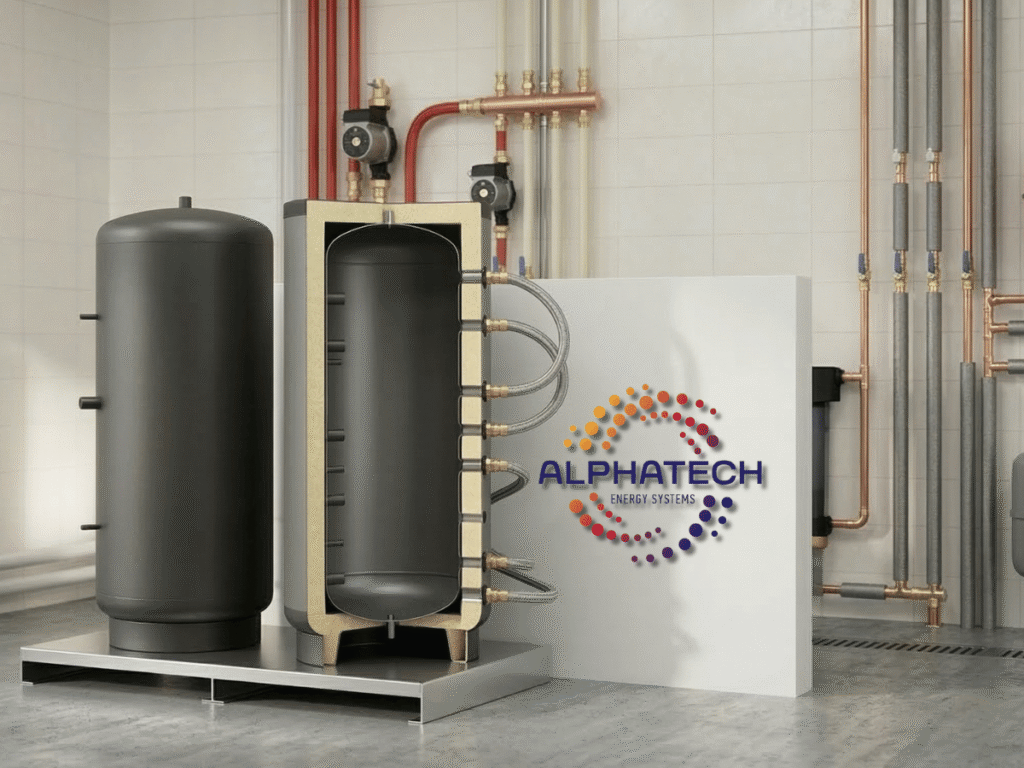
The Buffer acts like a “battery” of thermal energy. It is necessary in 3 main situations:
-
- To avoid frequent starts (Anti-Cycling): The biggest enemy of the compressor is short cycling. If the home's mains have a low water content (e.g. a few radiators or closed thermostats per room), the pump catches the target temperature too quickly and shuts down. After a while it starts up again. This wears out the machine and increases consumption. The Buffer adds the necessary volume of water to keep the pump running smoothly and continuously.
-
- For Defrost: In winter, and especially in areas with high humidity, the outdoor unit catches ice very often. To melt it, it reverses the cycle and steals some heat from the house. If there is no Hot Water Buffer, the pump will freeze the radiators to defrost, dropping the temperature in the house. The Buffer provides the energy to defrost without you even realizing it!
-
- When we have different heating zones: If the house has several thermostats that open and close different circuits, the water flow is constantly changing. The Buffer ensures that the pump will always have a constant flow of water, no matter what is going on inside the house.
-
- When installing a heat pump in an existing «difficult» network: Many heat pump installation applications are made in existing networks that have been sized for use with common boilers (e.g. oil, wood, gas). As a result, the network is not sufficient for proper flow and continuous operation of the CHP, making the installation of a buffer essential!
2. When is the Buffer not required? ;
But Buffer is not a «panacea» and should be avoided in certain cases
-
- In a new installation designed for the use of a heat pump: In a new installation where the responsible engineer has carried out the necessary loss study (EN 12831) and has properly designed the heating network system (EN 12828) for heat pump use, a buffer can have the opposite effect on the installation, stressing the pump and consuming more energy.
-
- In an existing installation of «sufficient size» : There are also cases where the piping and radiators/heaters were calculated «rich», for the standards of the time! In these cases, if the correct chemical cleaning is done beforehand , and the amount of water in the closed heating circuit is sufficient, then the heat pump installation can be done without the use of a buffer!
- When the heat pump circulator is sufficient for the hydraulic installation : Some pumps, such as the PANASONIC AQUAREA, have an INVERTER pump that can reach 11 manometers at a flow rate of 30L/min! With this pump the pump can operate in most installations without the requirement of a hydraulic buffer!
3. How many litres are needed?;
There is no “one size fits all”, and it depends on several factors shown below:
-
- Installation type (radiators, fan-coil, underfloor)
-
- Heat pump use (heating only, or cooling/heating)
-
- Number of heat pump defrosts per day
Example: Have a heat pump 9kW (e.g. Evitron Ecoprime or Panasonic Aquarea) connected to radiators only for heating in Thessaloniki. The minimum water volume in the system should be approx. 100 litres.
⚠️ Attention: If the house has underfloor heating, you may only need a small Buffer, or none at all. But if you have small radiators or Fan Coils, then the Buffer needs to be larger and is a one-way street.